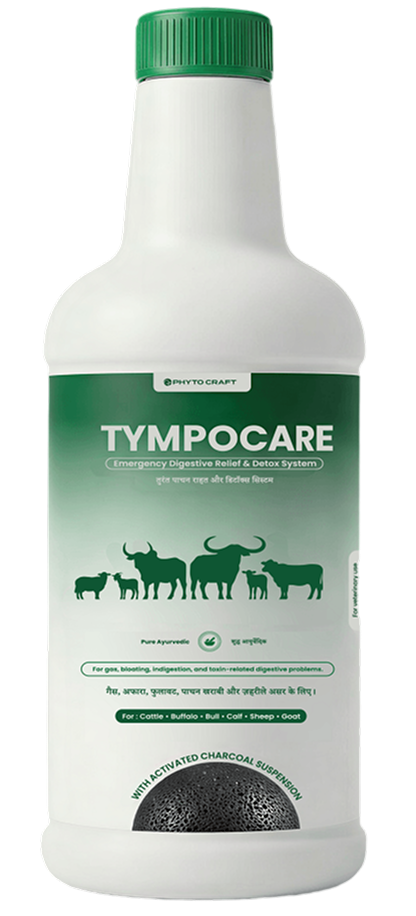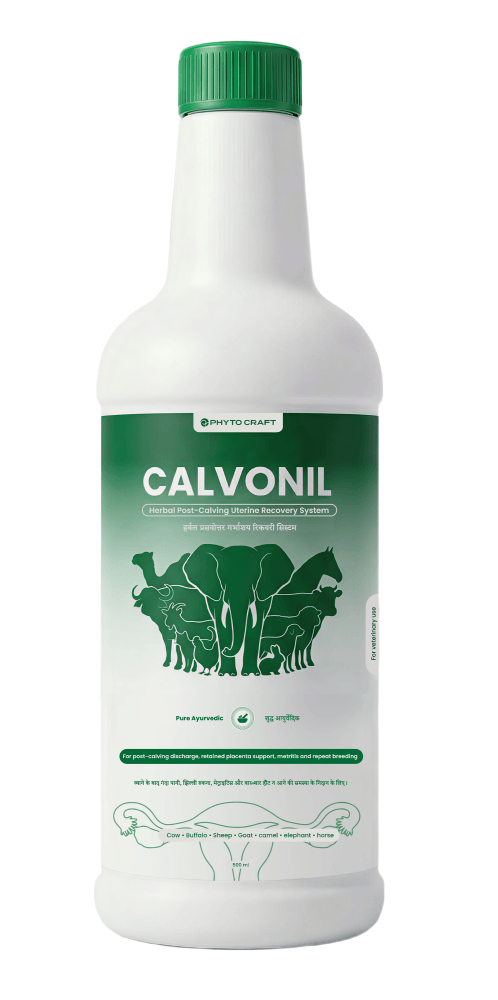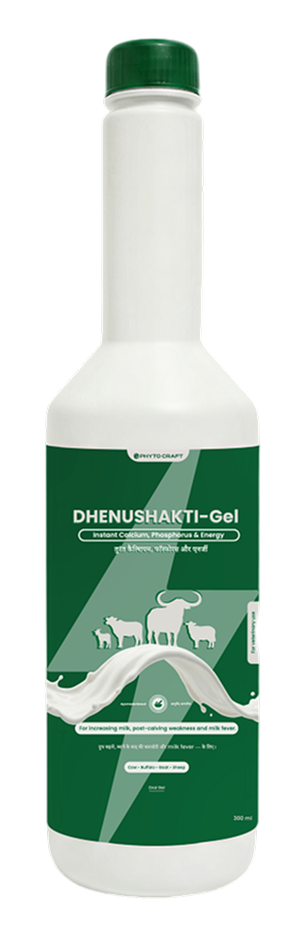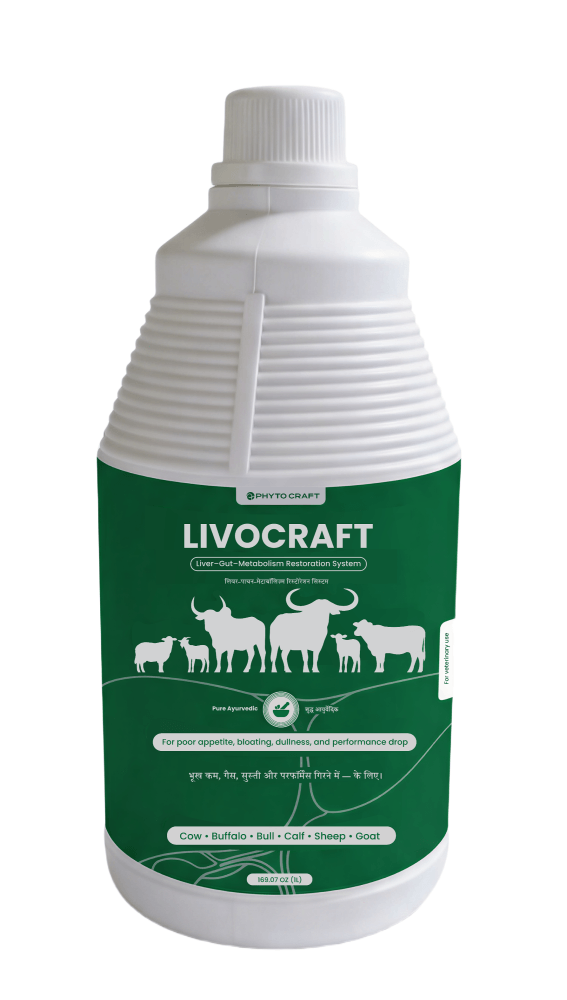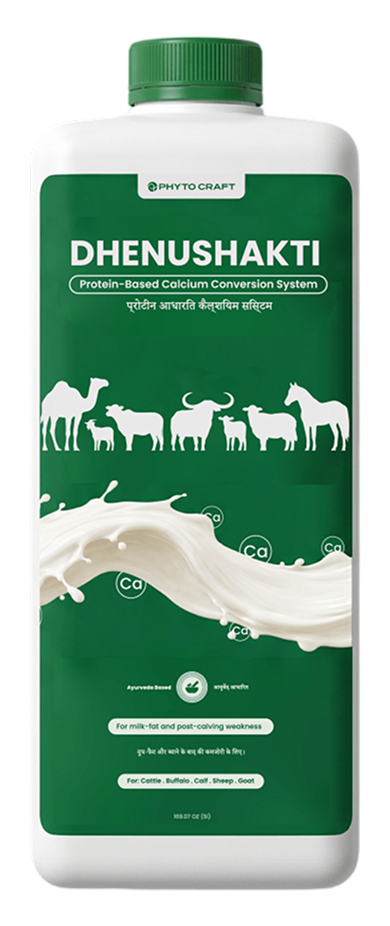
Dhenushakti

Dhenushakti

Protein-Based Calcium Conversion & Mineral Recovery System

Dhenushakti is not a calcium supplement. It is a calcium conversion system — built on the understanding that delivering calcium means nothing if the body cannot absorb and use it. After calving, illness, or metabolic stress, the calcium-phosphorus balance breaks down at a biological level that standard supplementation cannot fix. Dhenushakti restores mineral utilisation, neuromuscular stability, and milk-fat performance through a protein-based Ayurvedic formulation designed for the specific biological demands of the post-treatment and post-calving phase.

For Cow Buffalo Calf Sheep Goat Camel Horse
Pack 1 L 5 L 10 L 20 L
Pure Ayurvedic
Field-Tested
Vet-Backed
Zero Fillers
The Problem This Product Was Built to Solve

Your Animal Finished Treatment. The Real Problem Has Not.

Your animal is standing. It is eating — not well, but eating. The milk has not come back. The body looks weak. You are waiting for things to return to normal, and they are not returning.

This is not a slow recovery. This is a biological failure that nobody has addressed.

After calving or after any significant illness, the animal’s calcium and phosphorus reserves are critically depleted. What remains is a calcium-phosphorus imbalance that disrupts nerve signalling, muscle contraction, and metabolic efficiency simultaneously.

Standard calcium supplements deliver calcium in forms the depleted body absorbs poorly. The mineral arrives but is not utilised. The problem was never just low calcium — it was the body’s inability to absorb, convert, and deploy calcium effectively after the biological disruption of illness or birth.

Subclinical hypocalcaemia is the most underdiagnosed condition in dairy livestock. The animal does not collapse — it just never fully recovers.

Left unaddressed, this mineral conversion failure becomes the starting point for a cycle of poor performance, early re-illness, and reproductive inefficiency that persists through the next lactation cycle.

🦴

Calcium-phosphorus reserves collapse after calving or illness

The body pulled these minerals to fight disease or sustain the birthing process. What remains is a deficit the animal cannot self-correct without targeted support.

Nerve-to-muscle signalling breaks down

The animal cannot stand with full strength because nerve-to-muscle communication depends on calcium. It cannot convert feed efficiently because calcium governs the metabolic pathways that transform what the animal eats into energy and milk.

💊

Standard supplements fail at the absorption level

Supplementing without fixing absorption changes nothing. The mineral arrives. The body cannot use it.

📉

Milk, fat, and strength decline in silence

Milk stays low. Fat stays poor. Strength returns slowly or not at all. The farmer sees poor performance — not a diagnosis.

What This Product Restores

Biological Functions. Systematically Rebuilt.

Not general benefits. Specific biological restorations — each tied to an observable outcome the farmer will see.

🧪
Calcium Absorption Efficiency

Gastrointestinal and metabolic pathways

Milk improves within days not weeks
🦴
Phosphorus Balance

Skeletal and metabolic systems

Animal stands stronger, moves freely
Neuromuscular Function

Peripheral nervous system and musculature

Trembling stops, stands unaided
🥛
Milk Yield & Fat Conversion

Mammary and metabolic systems

Milk volume rises, fat improves
🐄
Post-Calving Physical Recovery

Whole-body mineral and metabolic systems

Eats more, regains weight faster
🔋
Mineral Reserve Stability

Long-term metabolic and skeletal systems

Sustained performance through lactation
Formulation Architecture

What Makes This Formulation Work

PhytoCraft formulations are not ingredient lists. They are systems — each complex selected for a specific biological function, each validated through Ayurvedic therapeutic science and field outcomes. We do not publish our formulations. We publish what they do.

Complex 1
Calcium Conversion Complex
Ayurvedic Class: Asthi-Poshak · Balya
What it does?

Gastrointestinal calcium absorption pathway — improving the rate at which calcium moves from the gut into systemic circulation.

Why it matters?

Addresses the core failure in post-illness and post-calving animals — not lack of calcium, but the body's reduced ability to absorb it. Converts supplemented calcium into biologically available mineral rather than passing it through unused.

Complex 2
Phosphorus Equilibrium Complex
Ayurvedic Class: Dhatu-Vardhak · Rasayana
What it does?

Calcium-to-phosphorus ratio governing nerve signalling and muscle contraction.

Why it matters?

When phosphorus balance is disrupted, calcium cannot function correctly regardless of how much is delivered. This complex corrects that ratio at a systemic level and supports sustained mineral stability through the recovery period.

Complex 3
Neuromuscular Restoration Complex
Ayurvedic Class: Balya · Vatahara
What it does?

Nerve-to-muscle interface depleted by mineral loss — the electrochemical signalling that determines muscular strength and coordination.

Why it matters?

Directly addresses the post-calving weakness and trembling that standard calcium delivery fails to resolve — by acting at the signalling level, not just the mineral delivery level.

Complex 4
Protein-Mediated Delivery Matrix
Ayurvedic Class: Mamsa-Poshak · Ojaskar
What it does?

Calcium binding to transport proteins in the intestinal wall — the mechanism that determines how much supplemented mineral actually enters the bloodstream.

Why it matters?

Without these protein cofactors, calcium passes through the gut largely unutilised. This matrix is what makes Dhenushakti a conversion system rather than a supplement.

Complex 5
Galactagogue & Fat-Metabolism Complex
Ayurvedic Class: Stanya-Janana · Vrushya
What it does?

Mammary function and the metabolic pathways that determine milk fat synthesis.

Why it matters?

Restores the biological conditions under which the mammary system can function at its natural capacity — not by stimulating production artificially, but by correcting the upstream mineral failure that suppressed it.

How It Works

The Root Cause. The Chain. The Fix.

Calving / Illness

Calcium-phosphorus reserves depleted

Absorption Failure

Gut cannot convert supplemented calcium into usable mineral

Visible Consequences

Weakness · Low milk · Poor fat · Slow recovery

Dhenushakti

Restores absorption efficiency and mineral conversion

Full Restoration

Neuromuscular function · Milk performance · Metabolic stability

1
Improves calcium bioavailability at the intestinal absorption level

Increasing how much of the supplemented mineral actually enters systemic circulation rather than being excreted unused.

2
Restores calcium-to-phosphorus ratio for nerve and muscle function

Required for effective nerve impulse transmission and sustained muscle contraction — both collapse when this ratio is disrupted.

3
Provides protein cofactors that bind calcium to intestinal transport proteins

The step that standard inorganic calcium supplements bypass entirely — and the reason those supplements fail in post-calving and post-illness animals.

4
Reactivates mammary metabolic pathways for milk fat synthesis

Suppressed during mineral depletion states — Dhenushakti restores the conditions for fat production rather than stimulating the mammary gland artificially.

When to Use

Situations This Product Is Built For

Post-calving weakness in cattle or buffalo

After birth, calcium reserves are at their lowest and gut absorption efficiency is impaired. Dhenushakti addresses the absorption failure, not just the deficit — producing significantly faster recovery than calcium supplementation alone.

Milk production does not return after calving

When milk volume and fat remain low weeks after delivery despite the animal eating and appearing stable — mineral conversion failure is almost always the cause.

Animal is shaking, trembling, or unsteady on its feet

Muscular trembling after calving or illness signals neuromuscular calcium-phosphorus failure. The mineral is present but not functioning correctly at the nerve-muscle interface.

After prolonged fever, diarrhoea, or metabolic disorder

Sustained fever and diarrhoea deplete mineral reserves rapidly and impair absorption pathways. After the illness is treated, these pathways do not restore themselves — Dhenushakti restarts them.

Low milk fat despite adequate feed

When fat content is consistently below normal and feed quality is not the issue — calcium-phosphorus imbalance affecting fat metabolism is the most likely cause.

After repeat calving complications or difficult deliveries

Animals experiencing difficult births, twins, or retained placenta have exceptional calcium depletion requiring systemic restoration, not just top-up mineral delivery.

During high production peak when mineral drain is accelerating

High-producing animals in peak lactation deplete calcium reserves faster than diet can replace them. Dhenushakti supports sustained mineral availability rather than allowing gradual subclinical depletion.

When NOT to Use

Situations Where This Is Not the Right Response

Collapsed, recumbent animal with milk fever

Full collapse requires intravenous calcium — no oral product acts fast enough. Dhenushakti Gel is appropriate for the acute oral phase. Dhenushakti liquid begins post-crisis stabilisation once the animal is standing and swallowing normally.

As a substitute for veterinary diagnosis in severe weakness

Weakness in livestock has multiple causes — some requiring immediate veterinary intervention. Confirm the cause before beginning supplementation.

Animals with confirmed kidney disease or mineral excretion disorders

Conditions that impair mineral regulation require veterinary management. Adding calcium conversion support without understanding the underlying excretion failure can worsen the imbalance.

What You Will See — Recovery Timeline

Observable Changes. Day by Day.

What to look for in your animal after starting this product. Written for the farmer — specific and observable.

3–5

Early Signs

  • Animal begins eating with more interest — finishes feed rather than leaving it
  • Trembling or unsteadiness reduces — animal stands more steadily
  • Milk volume shows a small but noticeable upward movement
  • Animal is less dull — starts looking around, responding to sound
  • Stool begins to firm up and normalise
7–10

Visible Recovery

  • Standing strength clearly improved — animal rises without struggling
  • Milk volume increased meaningfully, fat content begins to improve
  • Appetite strong and consistent — finishes feed and shows interest in more
  • Movement more confident — walks without hesitation or stiffness
  • Begins interacting normally — social behaviour and alertness return
14–21

Full Restoration

  • Milk at or approaching normal pre-illness or pre-calving levels
  • Fat content consistent and healthy — visible in richness and cream line
  • Body condition improving — animal regaining weight and muscle
  • Fully active, eating well, showing normal reproductive behaviour
  • Coat, eyes, energy, responsiveness — reflects an animal that has truly recovered
Dosage & Administration

Clear Dosage. By Species.

Species Dose Frequency Route
Cattle 100 ml Once Daily Oral
Buffalo 100 ml Once Daily Oral
Calf 40 ml Once Daily Oral
Sheep 30 ml Once Daily Oral
Goat 30 ml Once Daily Oral
Camel 100 ml Once Daily Oral
Horse 100 ml Once Daily Oral
Give directly by mouth — drench orally or mix into a small quantity of feed the animal will consume completely. Do not mix into the full feed ration
For best absorption, give in the morning before the first feeding. The gut absorbs calcium most efficiently in a lightly fed state
For calves, use a drench gun or feeding bottle to ensure the full 40 ml dose is delivered — calves may not consume it voluntarily when mixed into milk
Begin Dhenushakti within 24 to 48 hours of calving or immediately following the acute treatment course. Do not wait for visible signs — the depletion has already occurred
Post-Treatment Recovery Journey

Where Dhenushakti Sits in the Recovery Arc

This section answers one question clearly — at what stage in the animal's recovery does Dhenushakti belong, and what happens if that stage is skipped.

1

When does it begin?

Dhenushakti begins immediately — within 24 to 48 hours of calving, or on the day the acute treatment course ends. It does not wait for weakness to appear. By the time the animal is visibly struggling, the mineral conversion failure has been developing for days. Early entry is the difference between a 7-day recovery and a 21-day one.

2

What biological stage does it address?

Dhenushakti acts on the mineral conversion collapse stage — the period immediately following the physiological stress of birth or illness where calcium and phosphorus reserves are depleted and the gut's absorptive machinery is at reduced capacity. The crisis has passed. The animal is standing and eating. But the internal biological infrastructure for full performance has not rebuilt itself. This is the stage Dhenushakti owns.

3

What happens if this stage is skipped?

Without systematic mineral conversion support at this stage, the animal enters a subclinical deficit that does not announce itself loudly. Milk stays below its pre-illness level. Fat content remains poor. The animal moves carefully, eats inconsistently, and performs below its capacity — for weeks or months — until either the next illness hits a body that was never fully restored, or the farmer accepts the reduced output as the new normal. The deficit compounds with each production cycle.

4

How long does it remain relevant?

Dhenushakti's active recovery window runs from Day 1 post-treatment or post-calving through Day 21. The signals that tell the farmer this stage is complete are specific: milk has returned to its pre-illness level, the animal stands and moves without residual stiffness, fat content is consistent, and body condition is visibly improving. Once these markers are stable, the acute recovery stage is complete. High-producing animals in peak lactation may benefit from continued use as a maintenance product — but that is a sustained support decision, not an acute recovery one.

Precautions & Storage

What You Need to Know Before Using This Product

Precautions

  • Do not use as the sole intervention in a collapsed, recumbent animal — parenteral calcium is required first. Dhenushakti supports recovery after the emergency is stabilised, not during it
  • Do not give more than the recommended dose — excess mineral supplementation in animals with compromised kidney function creates electrolyte imbalance. Follow the dosage table precisely.
  • For calves under one month, confirm with your veterinarian before use — the neonatal gut has different absorption characteristics
  • Shake well before each use. The protein-based delivery matrix can settle — an unmixed dose will not deliver the full formulation
  • If no improvement after 10 days of consistent use, consult a veterinarian — the mineral depletion may be secondary to an underlying condition requiring diagnosis
  • This is a supportive formulation, not a replacement for diagnosis. Always rule out infection, mastitis, or systemic disease before attributing the condition to mineral failure alone

Storage

  • Store between 15°C and 30°C. Do not refrigerate — cold temperatures can alter the protein matrix and reduce formulation effectiveness
  • Keep away from direct sunlight. Store in a dark, cool place — UV exposure degrades the botanical actives
  • Keep the container tightly closed after each use. Exposure to air accelerates oxidation of the active complexes
  • Do not store near strong-smelling chemicals, pesticides, or fertilisers — the formulation can absorb environmental contaminants through the container
  • Keep out of reach of children and non-target animals

Frequently Asked Questions

Questions About Dhenushakti

Real questions from farmers and veterinarians — answered honestly and completely.

Dhenushakti is a protein-based calcium conversion system for livestock — meaning it does not just deliver calcium, it improves the body's ability to absorb and use it. After calving or illness, the gut's ability to absorb calcium breaks down. Dhenushakti restores that absorption pathway so the calcium the animal receives actually enters the bloodstream and does its job.

Post-calving weakness is almost always linked to calcium-phosphorus depletion and the body's failure to restore mineral balance quickly. Dhenushakti is built specifically for this situation. Start it within 24 hours of calving for best results — if it has been three days, start immediately. If the animal is completely collapsed and cannot stand, call your vet first for parenteral calcium and start Dhenushakti once the animal is stable.

Yes. Milk drop after illness or treatment is one of the clearest signs of mineral conversion failure — the metabolic pathways that produce milk and milk fat are dependent on calcium-phosphorus balance. Dhenushakti restores those pathways. You should see milk beginning to improve within 7 to 10 days of consistent use.

Low fat despite normal feeding is almost always a metabolic mineral problem, not a feed problem. Calcium and phosphorus govern the enzymatic pathways that convert feed into milk fat. When these minerals are depleted or poorly utilised, the fat content drops even if the diet is adequate. Dhenushakti corrects this at the metabolic level.

A normal calcium supplement delivers calcium in a form the body may or may not absorb depending on its current state. Dhenushakti delivers calcium with the protein cofactors that improve how much actually gets absorbed — the step most standard supplements skip. It also restores phosphorus balance, which most calcium supplements do not address at all.

Yes. Dhenushakti has no known interactions with antibiotics, anti-inflammatories, or other standard veterinary medications. It can and should be given alongside treatment — not after it. The earlier mineral restoration begins, the faster recovery follows.

Yes. Dhenushakti is safe for use in pregnant animals. Starting it in the dry period before calving can help prevent the mineral depletion that causes post-calving weakness — speak to your veterinarian about a pre-calving protocol.

Yes. The calf dose is 40 ml per day. For calves under one month old, confirm with your veterinarian. Calves with mineral deficiency benefit significantly from Dhenushakti — it supports bone development, strength, and healthy growth.

Mix it into a small portion of feed that the animal will definitely finish, or give it directly by mouth using a drench bottle or drench gun. Do not mix it into the full feed ration — if the animal does not finish all the feed, the dose is incomplete. For calves, a drench bottle is the most reliable method.

Morning, before the first feeding. The gut absorbs calcium most efficiently in a lightly fed state. Giving it before the main feed maximises absorption from the formulation.

Early signs — better appetite, reduced shaking, slight milk improvement — appear within 3 to 5 days. Visible recovery — stronger standing, clear milk increase, improved fat — by Day 7 to 10. Full restoration of milk, body condition, and strength by Day 14 to 21.

Continue the product and consult your veterinarian. If there is no response by Day 10, the weakness or low milk may have a cause beyond mineral depletion — mastitis, metabolic disease, or an underlying infection that needs diagnosis. Dhenushakti works reliably when the root cause is mineral conversion failure — but correct diagnosis matters.

Yes. The formulation is built for long-term biological safety. It does not contain synthetic chemicals or dependency-creating actives. High-producing animals in peak lactation can benefit from continuous use as a mineral maintenance product. Consult your vet for a long-term maintenance protocol if needed.

Yes — and this is exactly when Dhenushakti is most needed. The calcium injection treats the immediate crisis but does not fix the underlying absorption failure that caused the milk fever. Without Dhenushakti, many animals get a second episode within days. Dhenushakti addresses the root cause the injection bypasses.

Yes. The dose for sheep and goat is 30 ml per day. The formulation is indicated for all livestock including small ruminants, camel, and horse.

Yes. Sustained diarrhoea depletes calcium and phosphorus rapidly — through both reduced absorption and direct mineral loss. After the diarrhoea is treated, mineral restoration is essential. Dhenushakti is the correct product for this exact situation.

Post-calving trembling and shaking are signs that calcium-phosphorus levels are too low to maintain normal nerve-to-muscle signalling. Dhenushakti restores this — but if the shaking is severe or the animal cannot stand at all, call your vet immediately for injectable calcium first. Start Dhenushakti once the animal is stable.

For high-producing animals, yes — continuing at a maintenance dose through peak lactation prevents the gradual mineral depletion that leads to the next episode of weakness or low milk. For animals with a single episode of post-calving weakness, a full 21-day course followed by reassessment with your vet is recommended.

Yes — Dhenushakti is designed to work as part of a system. Using it alongside LivoCraft, Amritex, or AdvanceMin addresses different but interdependent biological systems simultaneously, producing faster and more complete recovery than any single product alone.

Do not stop a veterinarian-prescribed protocol without consulting your vet. Dhenushakti can be used alongside calcium boluses — it addresses the absorption side of the problem while boluses address the delivery side. Together they are more effective than either alone.

Dhenushakti is built on an Ayurvedic foundation — the therapeutic classes of herbs used have been validated through both classical Ayurvedic science and contemporary phytopharmacology. We do not use tradition as a substitute for validation. Every functional complex in the formulation is selected for a specific, confirmed biological action. Natural in philosophy. Scientific in execution. Ethical in outcome.

Our ETHOS

Connect with PhytoCraft

If you believe animal health deserves more depth, more honesty, and more compassion — you are already aligned with our purpose.