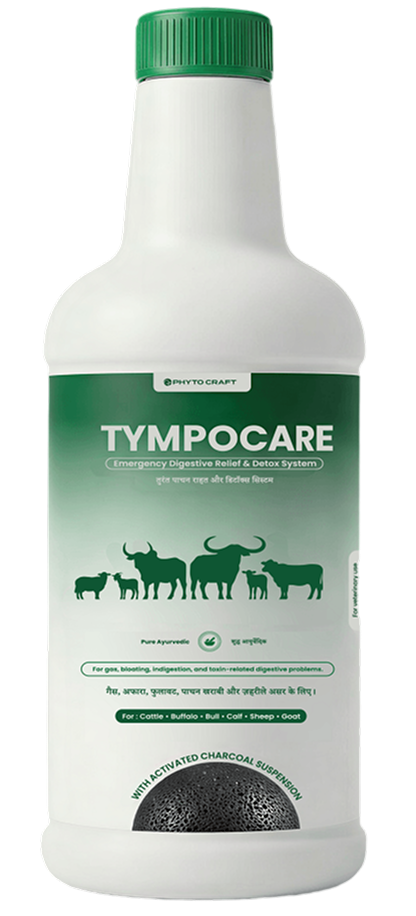
Tympocare

Tympocare

Emergency Digestive Relief & Detox System

Tympocare is a pure Ayurvedic emergency digestive relief system — built for the moments when an animal’s digestive system has failed suddenly and visibly. Bloating, gas, rumen overload, food poisoning, and acute indigestion are not slow problems — they escalate in hours and can become fatal if not addressed. Tympocare acts on five simultaneous mechanisms — binding feed-derived toxins, breaking rumen gas and foam, correcting rumen acidity, assisting intestinal clearance, and restoring microbial digestive stability — through pure plant science that acts fast because every herb in the formulation was selected specifically for speed and precision of digestive action.

For Cow Buffalo Bull Calf Sheep Goat
Pack 100 ml 500 ml
Pure Ayurvedic
Field-Tested
Vet-Backed
Zero Fillers
The Problem This Product Was Built to Solve

The Animal Was Fine at the Last Feeding. Now It Is Going Down.

The left flank is visibly swollen — bulging outward like a drum. The animal is restless, kicking at its belly, grinding its teeth. It has stopped ruminating. Its breathing is laboured because the distended rumen is pressing against the diaphragm.

Or it ate something contaminated — spoiled silage, a toxic plant, chemical residues in feed. Within hours it is dull, off feed, showing signs of abdominal distress, and deteriorating.

In frothy bloat, rumen contents form a stable foam that traps gas in millions of tiny bubbles — the animal cannot eructate because the gas is not free but locked throughout the rumen fluid. The rumen distends. The diaphragm is compressed. If not addressed, rumen rupture or death from asphyxiation follows.

In food poisoning, toxins bind to the intestinal wall, disrupt gut motility, cause mucosal inflammation, and enter systemic circulation. Speed of intervention is everything — every minute the toxin remains in the gut, more is absorbed.

Bloat that is not addressed within 1 to 2 hours of developing can be fatal. Tympocare exists because the farmer needs something that works in that window — before the vet, not after.

💨

Frothy bloat traps gas in stable foam — the animal cannot eructate it

The gas is not free — it is locked inside millions of foam bubbles. Straining to belch achieves nothing. The foam matrix must be broken before any gas can be expelled.

⚗️

Rumen acidosis kills the microbial community in a self-reinforcing cycle

As pH drops, acid-tolerant bacteria proliferate and produce more lactic acid, driving pH further down. Without pH correction, this cycle progresses to rumen wall damage and systemic acidaemia.

☣️

Every minute of toxin exposure in the gut is a minute more entering the bloodstream

Binding the toxin in the gut before it is absorbed is the single most important step in food poisoning management. Early administration produces dramatically better outcomes than waiting for signs to develop.

🕐

A gut that has stopped moving is a gut that is accumulating damage

Toxins that should be passing through are being absorbed. Gas is building. Restoring gut motility is what transitions the animal from crisis to recovery.

What This Product Restores

Biological Functions. Systematically Rebuilt.

Not general benefits. Specific biological restorations — each tied to an observable outcome the farmer will see.

💨
Rumen Gas Release & Foam Breakdown

Rumen and forestomach systems

Flank reduces, breathing eases, belching begins
⚖️
Rumen pH Balance

Rumen microbial and chemical environment

Teeth grinding stops, pain signs ease
🛡️
Toxin Binding & Clearance

Gastrointestinal lumen

Dullness reduces, normal behaviour returns
🔄
Gut Motility & Intestinal Clearance

Gastrointestinal tract

Animal passes dung — motility restored
🦠
Microbial Digestive Stability

Rumen and intestinal microbiome

Rumination returns — cud chewing resumes
🌾
Appetite Recovery

Gastrointestinal and hepatic systems

Interest in water and feed returns within hours
Formulation Architecture

What Makes This Formulation Work

PhytoCraft formulations are not ingredient lists. They are systems — each complex selected for a specific biological function, each validated through Ayurvedic therapeutic science and field outcomes. We do not publish our formulations. We publish what they do.

Complex 1
Carminative & Antifoaming Complex
Ayurvedic Class: Vatanulomana · Deepana · Pachana
What it does?

Breaks the stable foam that traps gas in frothy bloat — destabilising the surface tension of rumen foam bubbles and releasing trapped gas so it can be expelled through normal eructation. Simultaneously reduces new gas production through carminative action.

Why it matters?

Frothy bloat is gas that cannot be released because it is physically trapped in a stable foam matrix. An antifoaming action that breaks this matrix is the single most critical immediate intervention. This complex converts trapped gas into free gas the rumen can then expel through normal mechanisms.

Complex 2
Toxin Binding & Neutralisation Complex
Ayurvedic Class: Vishahara · Ama-Pachana · Shodhan
What it does?

Physically binds mycotoxins, chemical residues, plant toxins, and bacterial endotoxins in the gastrointestinal lumen — adsorbing them to botanical binding agents before they can cross the intestinal wall into systemic circulation.

Why it matters?

The speed at which the toxin is bound in the gut directly determines how much enters the bloodstream. This complex acts as a gastrointestinal trap — the faster Tympocare is administered after ingestion, the less systemic damage occurs.

Complex 3
Rumen pH Correction Complex
Ayurvedic Class: Katu-Tikta · Deepana · Agni-Vardhak
What it does?

Buffers the rumen pH disrupted by overload, acidosis, or fermentation imbalance — restoring the alkaline environment that normal rumen microbial function requires.

Why it matters?

Rumen acidosis kills the microbial community in a self-reinforcing lactic acid cycle. This complex interrupts that cycle — preventing the progression from acute acidosis to rumen wall damage and systemic lactic acidosis.

Complex 4
Intestinal Clearance & Motility Complex
Ayurvedic Class: Rechana · Anulomana · Srotoshodhana
What it does?

Stimulates intestinal peristaltic activity — restoring the gut motility that stops during digestive distress and that is essential for moving toxins, gas, and abnormal fermentation products through and out of the gastrointestinal tract.

Why it matters?

A gut that has stopped moving is accumulating. Restoring motility transitions the animal from crisis to recovery. The return of dung passage is the most reliable observable sign this complex is working.

Complex 5
Microbial Stabilisation Complex
Ayurvedic Class: Deepana-Pachana · Grahi · Agni-Vardhak
What it does?

Supports the restoration of the rumen's microbial balance disrupted by the digestive crisis — creating a biochemical environment in which beneficial fermentation microorganisms can restabilise and resume normal function.

Why it matters?

The rumen microbiome does not automatically restore itself after disruption. This complex supports the return of favourable microbial conditions — addressing the cause of recurring digestive instability, not just the acute episode.

How It Works

The Root Cause. The Chain. The Fix.

Feed Overload / Toxin Ingestion / Feed Change

Rumen fermentation balance disrupted

Gas & Foam Accumulate

Toxins enter circulation · Gut motility stops · pH crashes

Crisis Deepens

Visible bloating · Laboured breathing · Dullness · Abdominal pain

Tympocare

Breaks foam · Binds toxins · Buffers pH · Restores motility · Stabilises microbiome

Resolution

Gas expelled · Toxins cleared · Rumen function resumes · Animal returns to comfort

1
Breaks the stable foam matrix of frothy bloat — releasing trapped gas so the rumen can expel it through normal eructation

Not by increasing internal pressure — by destabilising the foam, converting trapped gas from a locked state to a free state the rumen can naturally eject.

2
Physically adsorbs mycotoxins, chemical residues, and plant toxins in the gut before absorption into systemic circulation

The speed of this action directly determines the extent of systemic damage. Early administration captures more toxin. Late administration manages the consequences of toxin already absorbed.

3
Buffers rumen pH in acidosis and overload — interrupting the lactic acid accumulation cycle before rumen wall damage

Breaking the self-reinforcing acidosis cycle before it progresses to systemic lactic acidaemia — the stage at which recovery becomes much harder and longer.

4
Restores intestinal peristaltic motility — transitioning the gut from paralysis to active transit

Enabling the clearance of toxins, gas, and abnormal fermentation products — and producing the most reliable observable recovery sign: the return of dung passage

When to Use

Situations This Product Is Built For

Sudden bloating — frothy or free gas

The animal's left flank is visibly distended, the animal is restless and in obvious distress, and breathing is laboured. Administer immediately — every minute of delay allows rumen pressure to increase further. Use while preparing to contact your veterinarian for assessment of severity.

Food poisoning or suspected toxin ingestion

The animal has had access to spoiled feed, contaminated water, aflatoxin-contaminated silage, toxic plants, or chemical residues in feed. Administer immediately. The toxin-binding complex needs to act in the gut before the toxin is absorbed — the sooner it is given, the more effective the toxin capture.

Rumen overload — grain or concentrate excess

An animal that has broken into a feed store, been given an excessive concentrate ration, or had a sudden change to a high-grain diet is at high risk of rumen acidosis. Administer Tympocare before clinical signs of acidosis develop — the pH correction complex buffers the environment before the lactic acid cascade progresses.

Indigestion from sudden feed change

When an animal shows signs of digestive discomfort — reduced appetite, reduced rumination, mild abdominal distension — following a change in feed type or source. Tympocare's microbial stabilisation and pH correction complexes address this before it progresses to clinical bloat or acidosis.

Appetite drop with digestive signs after feed change

An animal that has stopped eating, stopped ruminating, and is showing abdominal discomfort without full bloat is showing early signs of rumen dysfunction. Tympocare at this stage prevents escalation to acute bloat — addressing the fermentation imbalance before it becomes a crisis.

Post-bloat stabilisation after veterinary intervention

After a veterinarian has passed a stomach tube, trocarised, or otherwise managed an acute bloat episode, Tympocare supports the stabilisation of the rumen environment — reducing the risk of recurrence in the hours following the acute intervention.

When NOT to Use

Situations Where This Is Not the Right Response

In a fully collapsed animal requiring immediate surgical or veterinary emergency intervention

Severe bloat with the animal recumbent, cyanotic, or unresponsive requires immediate veterinary emergency intervention — stomach tube, trocarisation, or rumenotomy. Tympocare cannot relieve critical bloat pressure fast enough in a cardiovascular-compromised animal. Call your veterinarian immediately.

As a replacement for identifying and removing the cause

If the cause of bloating is ongoing — the animal still has access to the lush pasture or the contaminated feed is still being offered — Tympocare manages the episode but cannot prevent the next one. Identify and remove the cause alongside treating the crisis.

As a routine daily supplement

Tympocare is formulated for acute emergency use — the doses and botanical composition are designed for the intensity of a digestive crisis, not for daily maintenance. For ongoing rumen health and gut microbiome support in the post-treatment recovery phase, LivoCraft is the appropriate product.

What You Will See — Recovery Timeline

Observable Changes. In Minutes to Hours.

Tympocare is an acute emergency product. The recovery timeline is measured in minutes and hours. These are the specific responses to look for after administration.

If there is no meaningful improvement after two doses at the appropriate interval — bloat has not reduced, food poisoning signs are not improving — stop re-dosing and call your veterinarian. The cause may require physical intervention such as stomach tube passage or trocarisation that oral products cannot replace.

30–60 Minutes

First Response

  • Left flank begins to reduce in size — drum-tight distension softens as gas is released and expelled
  • Animal becomes less restless — kicking at the belly, teeth grinding, and anxious movement reduce
  • Breathing eases — as rumen distension reduces, the diaphragm is no longer compressed
  • Belching begins — audible gas expulsion is one of the clearest signs the antifoaming complex is working
  • Animal’s posture normalises — stops holding its body in the hunched, tense position that pain and pressure cause
2–4 Hours

Stabilisation

  • Bloating has substantially resolved — left flank looks normal or near-normal
  • Rumination begins to return — animal starts chewing its cud again, indicating rumen microbial function is restabilising
  • Dung is passed — gut motility has restored and the intestines are clearing
  • Animal shows interest in water — reliable sign that acute distress has passed
  • In food poisoning cases, dullness and systemic signs begin to reduce — toxin-binding action has reduced the systemic toxin load
Within 24 Hours

Recovery Confirmed

  • Animal eating normally — appetite fully returned and feed consumed without hesitation
  • Rumination consistent and sustained — normal rumen sounds present on auscultation
  • Dung passage normal in frequency and consistency
  • No residual signs of abdominal discomfort — normal posture, movement, no tail switching or belly kicking
  • In food poisoning cases, animal is fully alert and behaving normally — systemic signs have resolved
Dosage & Administration

By Condition and Species

Tympocare dosage is situation-based. The condition determines the dose before the species does.

Species Dose Frequency Route
How to administer: Use a drench bottle or drench gun to deliver directly into the side of the mouth and over the back of the tongue. Ensure the animal swallows before releasing. Do not attempt to drench an animal in severe respiratory distress or unable to swallow safely
Dose selection within the range: Use the lower end for mild to moderate bloat with the animal still standing and alert. Use the upper end for severe bloat with significant distension and signs of respiratory compromise. For food poisoning, always use the full dose regardless of apparent severity — toxin load is not visible
For food poisoning — act immediately: The moment you suspect the animal has ingested something harmful — administer before waiting for signs to develop. Early administration captures toxin in the gut. Late administration manages the consequences of absorption that has already occurred
After administration: Keep the animal moving gently — walking encourages eructation and gas expulsion. Do not confine a bloated animal in a small space immediately after drenching. Allow it room to move, stretch its neck, and belch freely.
Severe bloat precaution: In any bloat case where the animal is showing signs of respiratory distress — mouth breathing, blue tinge to mucous membranes, extreme distress — call your veterinarian immediately alongside administering Tympocare
Post-Treatment Recovery Journey

Where Tympocare Sits in the Recovery Arc

Tympocare is the first intervention in a digestive emergency. What follows it in the recovery sequence is for the products that address the aftermath.

1

When does it begin?

Tympocare begins at the moment the digestive crisis is identified — not after watching and waiting. It is the first response product for acute digestive emergencies in livestock. Its entry point is at the crisis itself — at the moment the farmer sees the bloated flank, recognises the food poisoning signs, or identifies the rumen overload. There is no earlier product in the recovery sequence — Tympocare is the starting point of the digestive emergency response.

2

What biological stage does it address?

Tympocare acts on the acute digestive crisis stage — the hours during which rumen gas accumulation, toxin absorption, or fermentation collapse is actively progressing and causing increasing biological damage. This is not a recovery stage — it is a crisis interruption stage. The biological window is measured in minutes and hours. The harm that occurs during this window — toxin absorption, rumen wall damage from pressure, cardiovascular compromise from diaphragm compression — is cumulative and irreversible if the crisis is allowed to progress unchecked.

3

What happens if this stage is not addressed?

Untreated frothy bloat kills. An animal in acute tympany that does not receive intervention within 1 to 2 hours faces rumen rupture, asphyxiation, or cardiovascular collapse from sustained abdominal pressure. Untreated food poisoning progresses to systemic toxaemia — the toxin absorbed from the gut damages the liver, kidneys, and nervous system in ways that cannot be reversed once absorption has occurred. The damage done in the acute crisis window is the damage that the animal carries through every subsequent stage of recovery.

4

How long does it remain relevant?

Tympocare's intervention window is a single episode — one dose, with a possible second dose if response is incomplete after 4 to 6 hours. The signal that tells the farmer the acute crisis stage is resolved is unmistakable — the bloat has subsided, the animal is breathing normally, rumination has returned, dung is being passed, and the animal is alert and showing interest in water and feed. What follows — rumen microbiome disruption, gut damage, and liver stress from toxin processing — is addressed by LivoCraft and Amritex, which should begin in the 24 hours following the acute episode.

Precautions & Storage

What You Need to Know Before Using This Product

Precautions

  • Do not administer to an animal that is unable to swallow safely — a fully collapsed, cyanotic, or unconscious animal cannot protect its airway and is at risk of aspiration. Physical emergency intervention by a veterinarian is required in this situation.
  • Severe bloat with respiratory compromise — mouth breathing, blue mucous membranes, extreme distress — is a veterinary emergency. Administer Tympocare as immediate first aid and call your veterinarian simultaneously. Do not delay the veterinary call while waiting to see if the oral product resolves a critical case
  • Do not use Tympocare as a daily routine product — the botanical composition and dose volume are calibrated for crisis intervention, not daily supplementation
  • If the animal shows no meaningful improvement after two doses at the appropriate interval, stop re-dosing and call your veterinarian. Recurrent or unresponsive bloat has a cause — physical obstruction, vagal indigestion, hardware disease — that requires diagnosis
  • For small ruminants, measure the dose carefully. The range of 100 to 250 ml must be measured and administered with a calibrated drench syringe — do not estimate volume in small animals
  • Keep the animal moving gently after administration — movement encourages eructation and gas expulsion. Do not immediately confine the animal after drenching

Storage

  • Store between 15°C and 30°C. Temperature extremes affect the stability of the carminative and antifoaming botanical actives — particularly in a liquid formulation that must act rapidly when administered
  • Keep away from direct sunlight. Store in a consistently cool, shaded location — UV exposure degrades the botanical actives that provide the antifoaming and toxin-binding action
  • Keep the container tightly sealed after each use. The carminative volatile compounds in the formulation are sensitive to air exposure and can diminish in potency with prolonged oxidation
  • Because Tympocare is an emergency product, store it in a location that is immediately accessible from where your animals are kept.
  • An emergency product that takes five minutes to find is an emergency product that arrives five minutes too late
  • Do not store near pesticides, fertilisers, or chemical inputs

Frequently Asked Questions

Questions About Tympocare

Real questions from farmers and veterinarians — answered honestly and completely.

Tympocare is a pure Ayurvedic emergency digestive relief system for livestock. Use it the moment you see sudden bloating, suspect food poisoning, identify rumen overload, or observe acute digestive distress in any cattle, buffalo, or small ruminant. It is a first-response product — its purpose is to act on the digestive crisis before it progresses, before the vet arrives, and before the biological damage becomes irreversible.

This is acute bloat — administer Tympocare immediately by oral drench. For a large animal give 250 to 500 ml depending on severity — use 500 ml if the distension is severe and breathing is laboured. After administering, call your veterinarian. Keep the animal moving gently and do not confine her. If she is in extreme distress — mouth breathing, blue gums, unable to stand — call the vet first and administer Tympocare simultaneously. This is a medical emergency.

The first signs of response — reduced flank distension, audible belching, reduced restlessness — are typically visible within 30 to 60 minutes of administration in bloat cases. Substantial resolution of the bloat should be apparent within 2 to 4 hours. In food poisoning cases, reduction in systemic signs of distress begins within 2 to 4 hours as toxin binding and gut clearance take effect.

Possibly — and administer Tympocare at the food poisoning dose immediately without waiting to confirm. If the animal has ingested something harmful, the toxin-binding complex needs to act in the gut before more toxin is absorbed. Early administration produces dramatically better outcomes than waiting. 500 ml for a large animal. Call your veterinarian as well — toxic plant or chemical ingestion in a buffalo requires veterinary assessment.

Yes. Calves are categorised as small animals for dosing purposes — use 250 ml for food poisoning and 100 to 250 ml for bloating and tympany. For very young calves, consult your veterinarian for dosing guidance as body weight matters more in neonates.

Yes — Tympocare contains no synthetic antifoaming agents, no pharmaceutical antibiotic components, and no synthetic carminatives. Every complex in the formulation is built from Ayurvedic therapeutic classes — Vatanulomana carminatives for gas relief, Vishahara botanicals for toxin binding, Katu-Tikta actives for rumen pH buffering, and Rechana-Anulomana botanicals for intestinal clearance. Why wait for a drug to be made, when Ayurveda already has the cure?

Give 100 to 250 ml — use the lower end if the bloat is mild and the goat is still alert and standing, the upper end if the distension is significant and the goat is showing distress. Administer by drench directly into the mouth. Keep the goat standing and moving gently after administration. If the goat does not improve within 1 to 2 hours or is deteriorating, call your veterinarian.

Yes. Tympocare's multi-mechanism action covers the most common causes of acute digestive emergency simultaneously — gas, foam, toxins, rumen pH disruption, and gut motility failure. You do not need to diagnose the specific cause before administering it. In any situation of acute digestive distress with bloating or suspected toxin ingestion, give Tympocare and call your veterinarian for assessment.

Tympocare resolves each acute episode effectively but recurring bloat has a persistent underlying cause — lush pasture access, consistently high-grain diet, a rumen microbiome that has not restabilised, or a physical condition like vagal indigestion — that requires identification and management. Use Tympocare for each episode and consult your veterinarian about the recurring pattern. Tympocare manages the crisis — the root cause needs to be addressed separately to prevent recurrence.

Yes. Tympocare has no known interactions with standard veterinary medications. In acute bloat cases where the veterinarian has also prescribed or administered pharmacological treatment, Tympocare complements rather than competes with that intervention — it addresses the rumen environment directly while any pharmacological treatment addresses its specific target.

Tympocare is an emergency product — it acts on the acute digestive crisis in the hours of the emergency. LivoCraft is a Post-Treatment Recovery product — it rebuilds the liver, gut microbiome, and metabolic efficiency over a 14 to 21 day recovery arc following any illness including a digestive emergency. They address completely different stages and ideally both are used — Tympocare for the crisis and LivoCraft beginning in the 24 hours after the crisis resolves.

Give it before. Do not wait for the vet to arrive before administering Tympocare in an acute bloat or food poisoning situation — the biological damage that accumulates in the hours of delay is significant. Tympocare is first-line emergency support that buys time and reduces the severity of the crisis while veterinary assistance is arranged. Administering it before the vet arrives does not interfere with veterinary treatment — it supports it.

Recurring bloat within a short period suggests the underlying cause has not been addressed — the animal still has access to the triggering feed, or the rumen microbiome has not fully restabilised between episodes. Give Tympocare for the current episode and urgently consult your veterinarian about the pattern. Recurring bloat can indicate a more serious underlying condition — vagal indigestion, hardware disease, or structural rumen problems — that requires diagnosis.

After the acute crisis resolves, the rumen microbiome and gut function have been disrupted and the liver has been stressed by toxin processing. Begin LivoCraft the day after the episode — it rebuilds the liver, restores the rumen microbiome, and restores metabolic efficiency. For animals that experienced significant toxin ingestion, adding Amritex addresses the vitamin and mineral depletion that the stress and toxin load caused. These products complete the recovery that Tympocare begins.

Yes — give 250 ml immediately at the food poisoning dose for small animals. Time is critical in toxic plant ingestion — the faster the toxin-binding complex reaches the gut, the less toxin enters systemic circulation. Administer Tympocare and contact your veterinarian simultaneously. Toxic plant ingestion in sheep can include plants affecting the nervous system or kidneys — veterinary assessment is essential alongside the immediate oral intervention.

Store it in a location that is immediately accessible from where your animals are kept — not in a locked shed or distant storage room. An emergency product that takes five minutes to find is an emergency product that arrives five minutes too late. Keep it at room temperature, away from direct sunlight, with the cap sealed. Check the expiry date when you restock so you are never reaching for an expired bottle in a crisis.

Our ETHOS

Connect with PhytoCraft

If you believe animal health deserves more depth, more honesty, and more compassion — you are already aligned with our purpose.